
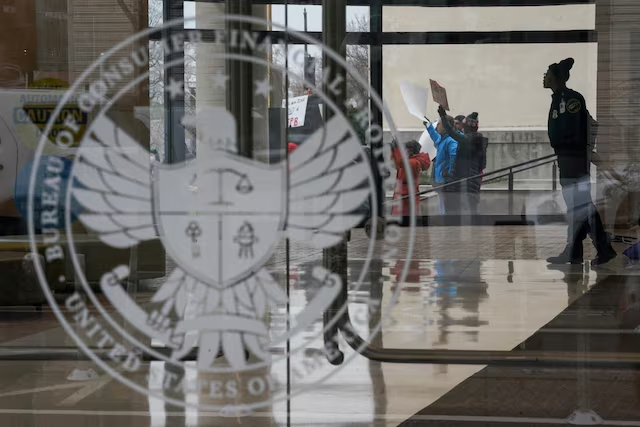
A new report claims Trump administration changes to Consumer Financial Protection Bureau policies led to billions in lost restitution and weaker consumer safeguards.
Major U.S. consumer advocacy groups allege that regulatory rollbacks implemented during the Trump administration at the Consumer Financial Protection Bureau (CFPB) have cost American consumers more than $18 billion. According to a detailed report released Monday, these losses stem from diminished restitution, weakened enforcement, and scaled-back consumer protections over a four-year period, sparking fresh debate about the impact of financial deregulation.
Consumer Groups Sound Alarm Over CFPB Policy Shifts
The report, compiled and released by a coalition including Americans for Financial Reform and the Center for Responsible Lending, builds its case on public CFPB records, enforcement data, and expert analysis. According to the report’s authors, changes enacted between 2017 and 2021, during President Donald Trump’s tenure, led to “unprecedented weakening” of the CFPB’s oversight of banks, lenders, and debt collectors.
“The numbers are stark,” said Lauren Saunders, associate director of the National Consumer Law Center, one of the report’s contributors. “The rollback of CFPB enforcement under the Trump administration directly led to real, measurable financial harm for U.S. households.”
Key Findings: Enforcement Declines and Financial Impact
Among the report’s most notable findings:
Enforcement Relief: The CFPB ordered only $1.8 billion in consumer restitution from 2018 to 2020, compared to over $11.4 billion from 2015 to 2017.
Case Volume: Enforcement actions dropped by more than 60%, reducing the deterrent effect on predatory lenders and fraudulent actors.
Policy Rollbacks: Protections for payday and auto title loan borrowers were weakened, making vulnerable consumers more susceptible to high-cost lending traps.
$18 Billion in Harm: The coalition estimates the net financial harm to consumers at $18 billion, factoring in lost recoveries and increased exposure to unfair practices.
“These numbers don’t just represent dollars and cents—behind every statistic is a family, a student, or a service member who faced elevated risks and diminished redress,” said Mike Calhoun, president of the Center for Responsible Lending.
Deregulation or Consumer Harm? Political Battle Lines Re-Emerge
The Trump administration and supporters of the regulatory changes have argued that the CFPB, created after the 2008 financial crisis, was overly aggressive and stifled innovation with burdensome red tape. Mick Mulvaney, who served as acting CFPB director from 2017 to 2018, argued that the agency had to be reined in.
Speaking to Reuters in 2019, Mulvaney maintained, “Our job is not to run roughshod over financial institutions, but to ensure consumers have choices and fair treatment.” Industry lobbyists echoed the sentiment, claiming lighter regulation helped expand access to credit and reduce compliance costs for small banks and lenders.
However, consumer advocates counter that scaled-back enforcement enabled bad actors. “We understand the need for a balanced regulatory approach,” said Saunders. “But what happened during these years tipped the scale too far, making it easier for predatory practices to return.”
Broader Economic and Social Implications
The report’s findings arrive amid growing discussion over household financial security and the role of federal regulators. Analysts suggest the effects of these policy shifts may have been felt most acutely by minorities, low-income families, and military members—groups CFPB was initially designed to protect.
“In times of economic uncertainty, strong consumer protection is more important than ever,” noted Aaron Klein, a research fellow at the Brookings Institution (not affiliated with the report). “A weakened CFPB means fewer tools to address fraud, discrimination, and deceptive practices.”
Response From the CFPB and the Trump Campaign
When reached for comment, the CFPB did not address the specific findings but stated, “The Bureau remains committed to its mission of protecting consumers and ensuring fair financial markets.” The agency pointed to recent steps under the Biden administration to restore enforcement capacity and review previously rescinded protections for payday borrowers.
A spokesperson for President Trump’s 2024 campaign dismissed the report as politically motivated, saying, “Under President Trump, the economy was stronger and consumers benefitted from greater choice and lower regulatory burdens.”
Restoration Efforts and the Future of Financial Protection
Since taking office, the Biden administration has moved to restore many CFPB powers and priorities. Rohit Chopra, current CFPB Director, has increased enforcement actions and reintroduced rules targeting payday and debt collection abuses.
“Our findings should serve as a warning,” said Calhoun. “Protecting consumers must remain at the center of the CFPB’s mission—regardless of political changes in Washington.”
The new report brings renewed scrutiny to one of the Trump administration’s most controversial deregulatory campaigns, raising fundamental questions about the balance between financial innovation and protecting ordinary Americans from harm. As the 2024 election cycle heats up, the debate over the scope and strength of financial watchdogs is likely to intensify—putting the CFPB’s priorities at the forefront of policy discussions.
Sources Used:
- Reuters, “Trump’s CFPB rollback has cost Americans $18 billion, consumer groups say,” June 24, 2025
- National Consumer Law Center press releases
- Center for Responsible Lending research
- Brookings Institution commentary on CFPB policy
- Public CFPB enforcement database


