
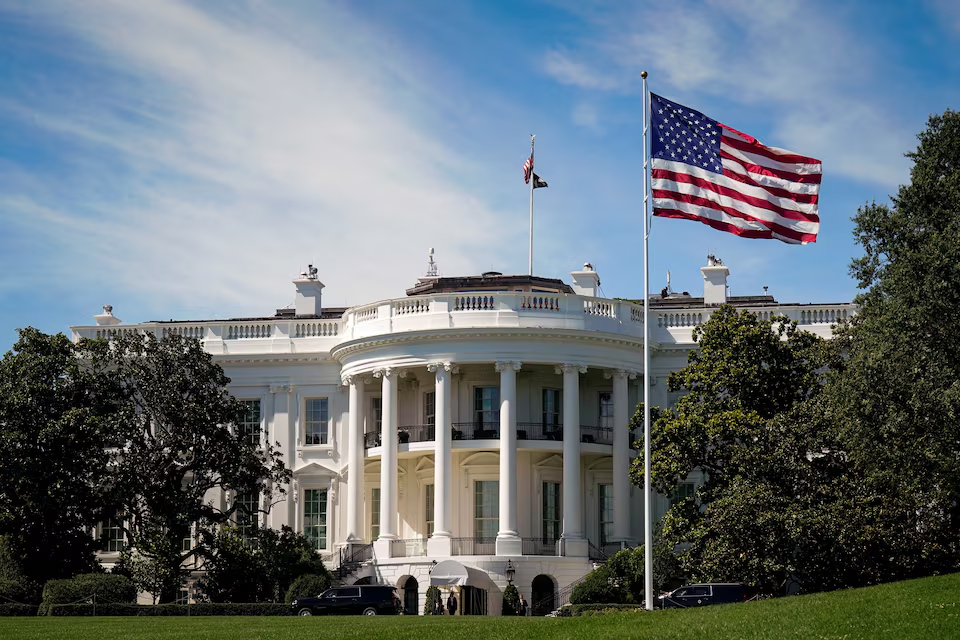
The White House is planning to sign an executive order to crack down on banks that allegedly terminate customers for political purposes, a step which could raise the temperature between the banking sector and the federal government. The Wall Street Journal reports that the draft order directs federal regulators to probe whether banks are breaking federal laws, including the Equal Credit Opportunity Act, antitrust laws, or consumer protection rules, when making politically charged account decisions.
The measure, to be signed as early as this week, would give regulators the authority to levy fines, negotiate consent decrees or other disciplinary measures against those who violate the regulations. In addition, the measure urges agencies to reconsider their own internal policies which may have caused banks to shed customers based on political affinities or affiliations with contentious industries.
The White House has not commented publicly on the draft, but those familiar with the situation tell us the order is part of President Donald Trump’s wider push to fight what he and other conservatives have branded “woke capitalism”. That is corporate policy that is seen as discriminating against people or companies for expressing right-of-centre or non-mainstream political opinions.
Origins of the Controversy
President Trump assailed the leadership of key financial institutions—specifically JPMorgan Chase and Bank of America—in January of 2025 for refusing to serve conservatives. Both banks vehemently denied basing their decisions on political opinion. But the charges unleashed renewed questioning from congressional Republicans and Republican-controlled state governments, many of whom complain that banks are practising ideological discrimination by refusing service to companies such as gun manufacturers, fossil fuel companies, and politically conservative lobbying groups.
This account has resonated with a large number of GOP lawmakers who perceive such actions as part of a larger initiative by corporate America to impose progressive values. Reacting to this, the Trump administration is also addressing broader financial regulation reforms, such as capital requirements, within the context of an attempt to stimulate economic growth and innovation.
Potential Impacts
If enforced, the executive order would potentially transform the way banks evaluate reputational risk and compliance benchmarks. Banks, financial critics say, have a right to refrain from doing business with clients that are deemed high-risk or troublemaking for their reputation. But proponents of the order contend that ideological discrimination by banks is tantamount to a threat to democratic and economic freedoms.
In addition, the order allegedly directs the Small Business Administration (SBA) to examine the practices of banks that back SBA loans, expanding the scope of this policy change even further.
The industry is paying close attention. Most institutions have more and more incorporated environmental, social, and governance (ESG) standards into their business models. The proposed crackdown may disrupt those models, particularly where they overlap with politically contentious topics.
Though it is unclear how forcefully regulators will move, the order represents a key initiative from the White House to challenge perceived ideological bias in America’s financial sector.
FAQs
What is the central purpose of this executive order?
The main objective is to stop banks from losing customers or refusing services due to political affiliations or ideology. It aims at financial fairness and adherence to current legislation such as the Equal Credit Opportunity Act.
Which banks are under fire?
JPMorgan Chase and Bank of America were singled out by President Trump in previous statements, though both institutions have refuted the practice of politically driven closure of accounts.
What statutes does the executive order invoke?
The order invokes the Equal Credit Opportunity Act, antitrust laws, and consumer protection laws. Regulators are mandated to examine possible violations of these laws against politically motivated activity.
In what ways will banks be sanctioned?
Regulators might levy monetary fines, impose consent decrees, or take other disciplinary actions if institutions are in violation.
What industries are thought to be being targeted by banks?
Conservatives argue that gunmakers, oil companies, and politically conservative groups have been unfairly shut out of financial services on the basis of ideology.
This executive order, if completed, would likely reawaken debates over free enterprise, corporate social responsibility, and government involvement in regulating ideological impartiality in business.


