
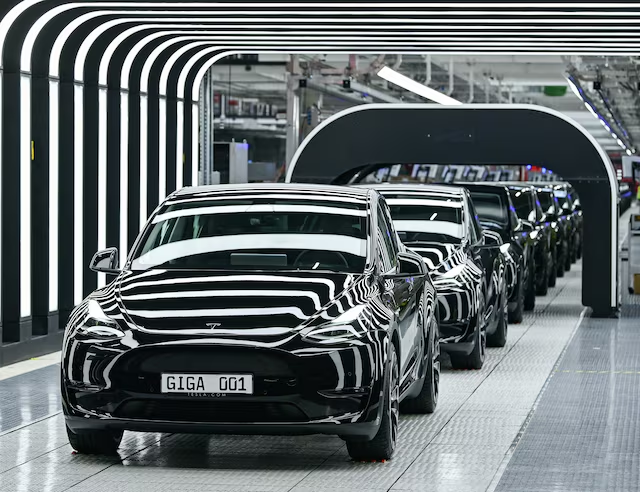
Tesla’s electric vehicle sales in Europe dropped for the fifth consecutive month in May, highlighting intensifying competition from both established and new European manufacturers. The latest data, reported by Reuters, shows that Tesla’s European market share has fallen to its lowest point since 2021, even as overall EV sales across the continent continue to climb.
Tesla Faces Mounting Pressure in the World’s Most Competitive EV Market
According to figures released by the European Automobile Manufacturers Association (ACEA), Tesla sold just under 11,300 vehicles in key European markets in May 2025, marking a 15% decline year-over-year. In contrast, European brands such as Volkswagen, Renault, and newcomers like China’s BYD have expanded their footprints, benefiting from new models, aggressive pricing strategies, and increasing consumer interest in homegrown options.
“The European automotive landscape is undergoing a pivotal transition,” said Ferdinand Dudenhöffer, director of the Center Automotive Research in Duisburg. “Tesla was an early EV leader, but traditional automakers are now leveraging their scale and local production to win over consumers.”
German and French Automakers Lead the Charge
Volkswagen Group, the continent’s largest automaker, saw EV deliveries rise by 11% during the same period, according to company data. Renault Group, buoyed by its newly launched Megane E-Tech, posted a 9% surge in sales, while Stellantis logged consistent gains with the Fiat 500e and Peugeot e-208. Analysts attribute this momentum to competitive pricing, expanded charging infrastructure, and robust government incentives.
German authorities, for example, recently renewed subsidies for EV buyers, providing up to €4,500 ($4,850) per vehicle. France continues to bolster EV adoption with both purchase incentives and substantial investment in domestic battery production.
Asia’s Ambitious Entrants Intensify Price Competition
Chinese automaker BYD’s European operations gained further traction in Q2, with the Atto 3 and Seal models receiving positive reviews and brisk sales in Norway, Sweden, and Germany. “European consumers are increasingly open to nontraditional brands, especially when they offer better value and innovative features,” said Sofia Givoni, a Zurich-based auto market analyst with JATO Dynamics.
Such competition is pushing prices downward and putting pressure on profit margins. While Tesla’s standard Model 3 and Model Y remain popular, their pricing is now closely matched—or even undercut—by rivals in some countries.
Tesla’s Unique Challenges in Europe
Tesla’s market share dropped below 9% of the European EV segment in May, down from a high of 13% in late 2021, ACEA data shows. Several factors are behind the decline:
Limited Model Lineup: The Model 3 and Model Y, which make up most of Tesla’s European sales, face increasing competition from a wider range of body styles offered by other brands.
Factory Output Constraints: Temporary slowdowns at Tesla’s Berlin Gigafactory due to supply chain issues have dampened deliveries.
Sluggish Response to Incentive Changes: Unlike major European rivals, Tesla has been slower to adapt to eligibility changes within national EV subsidy programs.
Tesla did not immediately respond to Reuters’ request for comment on its recent European performance.
Industry Perspectives: “It’s a Marathon, Not a Sprint”
Despite the recent setbacks, industry experts are not counting Tesla out. “This is a marathon, not a sprint,” said Matthias Schmidt, a Berlin-based automotive analyst. “If Tesla can accelerate its model diversification and maintain its reputation for software innovation, it could still recapture lost ground.”
Investors are keenly watching whether Tesla CEO Elon Musk will unveil new models tailored to European tastes, such as smaller hatchbacks and crossovers, which are among the top sellers in markets like Germany, France, and the UK.
Looking Ahead: Can Tesla Regain Its European Edge?
The landscape is rapidly shifting as more automakers launch EVs and governments remain committed to phasing out combustion engines. With nearly 41% of new vehicles registered in Europe in May being electric or hybrid, the race for dominance has never been fiercer.
Continued innovation, prompt response to consumer demand, and savvy engagement with policy shifts will be vital for Tesla’s long-term prospects in Europe’s lucrative and fast-evolving EV market.
Sources Used
- Reuters, “Tesla’s European sales slump for fifth month as EV rivals gain momentum”, June 25, 2025: Reuters Article
- European Automobile Manufacturers Association (ACEA): www.acea.auto
- JATO Dynamics industry analysis
- Statements and market data from Volkswagen, Renault, Stellantis, and BYD
- Interviews and analysis by Ferdinand Dudenhöffer and Matthias Schmidt (quoted in Reuters and industry publications)


